Way Home is a serious game focused on occupational therapy in a psychiatric ward of a day hospital where the player has to maintain a home.
This project was a collaborative project that originated from a Serious Games subject at my master’s degree. In this subject, I learned about these kinds of games and it actually opened my eyes about games beyond entertainment.
A collaboration was proposed to Gael and me through our teacher, Luz Castro and we accepted it as a challenge and a way to learn about Serious Games.
I was responsible for:
- Developed a scalable progression system using the Observer pattern to decouple game logic
- Implemented a data-driven task management system using Unreal Data Tables
- Programmed interactive elements and the day/night cycle logic
- Created Actor Components for modular behavior and material switching
- Collaborated with healthcare professionals to translate therapeutic requirements into gameplay mechanics
Process
First meeting
The project began with a collaborative meeting with the client, who was working at a day hospital for psychiatric patients, and other students enrolled in the master’s degree.
She showed the requirements and asked for a game that could help patients with occupational therapy since they lacked a space to do it. The objective was a game that could support therapy sessions and help people who have been through much time out of their homes.
In this first meeting, we also learned about the therapy occupation and delved into the details of these therapy sessions.
The idea
From here, we called for help for other students enrolled in the master’s degree and we started brainstorming ideas.
After refining the concept with Gael, we developed a GDD where we presented the idea of a virtual home where the player has to care about it.
We needed simple controls to make it easy for the player to interact with the game and we also needed to make it easy for the player to understand the game.
We aimed for iterative gameplay where the player can develop a habit through repeating processes. They should learn about utensils used in the tasks, relative cost, frequency of the tasks and realise about all the tasks that are needed to be done.
Designing this game was truly a challenge. Not just for the accessibility aspect, but for prioritizing utility of the game over entertainment, without removing the fun of the formula. Something we found hard to balance as our first Serious Game.
It was a constant exercise about realizing that some of the ideas for the project did not add value to the objective of the game; and concept distillation and adaptation.
An example of this was the day/night cycle. We first thought about an energy system where the player had some points to spend on doing tasks. When the player ran out of points, they cannot keep doing tasks and should sleep and continue to next day to refill his energy.
This idea was presented to deepen the gameplay and add some management aspect to the game. However, it was not a good idea since it added complexity and ran the risk of making the game about managing this resource instead of learning about the tasks and develop a habit.
So, instead of a restricted system we decided that the player could do any task they wanted, but the game would subtly guide the player to go to sleep by changing the lighting of the scene and making it harder to see the instances and the image, imitating a real day/night cycle.

The game was in constant iteration with the client and we also had to deal with the limited time since we only had 3 months to design and develop a prototype.
You can read the GDD made by Gael and me here!
Implementation
The game was implemented in Unreal Engine and my biggest contribution was the development of a scalable progression system.
The system relies on a ProgressComponent that manages all the progress of the tasks defined in a Unreal’s Data Table. It takes into account the frequency and dependencies of the tasks while keeping into account the progress of the days and the delayed tasks.
The idea was to make a system based on the Observer pattern ruled by this ProgressComponent. This way, Actors (in this case, home furniture) do not run any game logic and they only should subscribe to any task and automatically begin to react to any change in the task.
Then, the actor would update its appearance and behavior according to delayed days, task marked as to-do, days to next time… totally decoupled from the game logic.
This facilitated us the development of all the tasks since they can be developed individually without any dependency on the progress of the game. Every Actor is only responsible for updating its appearance.
I wrote about this system in a little notion document with Blueprint samples.
I also handled click and release events for the utensils, developed the base logic to handle the day/night cycle, made some ActorComponents for facilitating the material switching of the actors and simple animations, a system of emotes for showing alerts and UI.
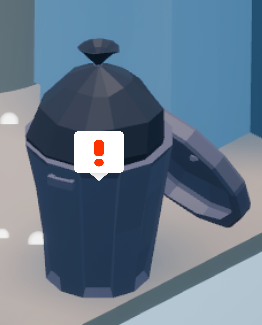
The game also has a feature that helps health professionals to track the progress of the patient by showing a text file with events in the game. Gael was responsible for this system and sound design and implementation.
Awards
This project was presented as a “aprendizaje servicio” (service learning) at the University of A Coruña.
Also we received the XXIV Amizade Award of the Rotary Club of Ferrol. Due to this award, we received interest from local press to talk about the project and it has been presented as finalist as Best Academic Project in Games and Learning Alliance Conference 2025.
Future work
Since this game is a proof of concept, it has a lot of room for improvement, such as better visual feedback, more tasks and a better user experience. We are working on testing the game in real sessions and measure the results to see if it can be a good tool for occupational therapy.
Until now, we have received positive feedback from showing the game to health professionals so we are expecting to keep improving it!